Thursday, 24 March 2011

PR currently lacks role in MBA curriculum - "a notable omission"

An important initiative from the PR Society of America - getting PR in general and in particular reputation management and corporate communications onto the MBA timetable as a recemt comment piece in the FT highlights.   As PR has now got into the boardroom as a strategic management function surely it must be only time before it becomes part of the MBA curriculum?  However, has PR yet got enough influence or academic credibility within the great business schools to effect this change?

                                          Harvard Business School - birthplace of MBA.

I am not sure.  For example, the Said Business School at Oxford which has a Centre for Corporate Reputation shows no apparent interest in PR's contribution to the subject when I last looked.  Certainly when PR does get onto the MBA curriculum does it will be an important milestone on the professionalisation of PR. 

Wednesday, 29 December 2010

Michael Porter sets agenda for 2011

Sure to be a must-read piece for those involved in corporate communications, financial PR, corporate governance and public affairs, is an article by Professor Michael Porter and colleague Mark Kramer in this month's Harvard Business Review.  Famous for his work on competitive forces and industrial clusters, Porter is damning on business, short termism and failure to put society or "shared value" at the heart of its business activites.
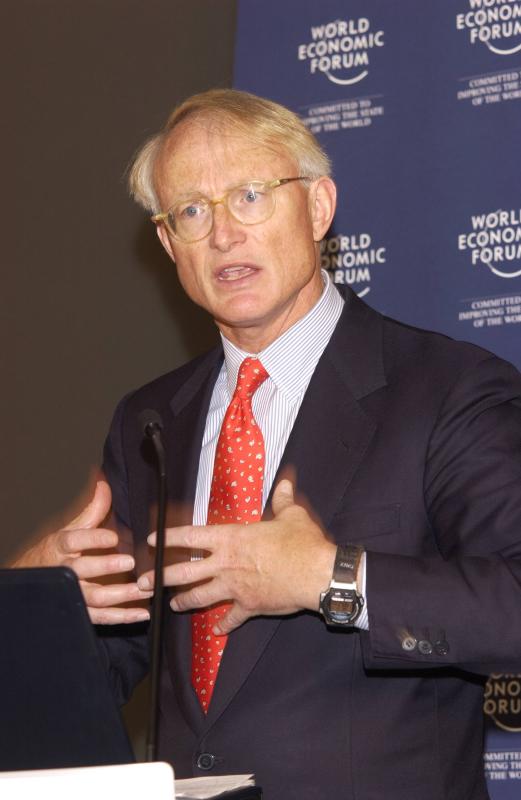
 Michael Porter.
"The capitalist system is under siege. In recent years business increasingly has been viewed as a major cause of social, environmental, and economic problems. Companies are widely perceived to be prospering at the expense of the broader community."  A major theme of the article is the concept of "shared value" which the authors say is not CSR or philanthropy but "reconnecting business with social progress."

Coming from the pen of such a leading figure in business strategy, and in a leading business publication, the article is sure to put more focus on the stakeholder/shareholder debate; and also the more modern framing of the argument around concepts such as sustainability and the need for organisations to think about and implement such concepts in a more fundamental way.

Wednesday, 15 December 2010

Is Rolls-Royce too wedded to key stakeholder relationships?

Following Rolls-Royce's handling of communications as a result of the major engine problems on the new giant Airbus has been instructive if somewhat painful from a UK PR plc perspective.  No wonder, that according to PR Week's latest edition, it is in discussions with leading consultancies on getting some additional help. One or two of the media have even linked it to BP in terms of a major UK brand not understanding the new rules particularly in a crisis PR situation.
(Image: Wing damage to Rolls-Royce powered Quantas new generation Airbus A380 which landed safely in Singapore.)

What are the new rules?  Well that is an exaggeration - but I think that social media has enhanced the role of a more generalised public opinion as opposed to a key stakeholder approach which is the approach which Rolls-Royce took in response to the situation.  The trouble with this is that the company decides if a stakeholder community is important and of course it may be that public opinion decides that actually travel safety issues are of a great deal of interest to many of us, not just investors, customers of Rolls-Royce and regulators, something which Lex in the Financial Times pointed out. The response of Quantas, operators of the plane in question, was particularly instructive and showed it understood about the need for a wider communication approach to the incident.

It turns out courtesy of CorporateComms that the Director of Communications at Rolls-Royce does not believe in the impact of social media which seems unfortunate in the context and particuarly so as other media are now developing this aspect of the story.

For those PR practitioners interested in reading more regarding the role of generalised public opinion particuarly in crisis PR situations, there is a very good paper in the academic journal Corporate Communications by Oyvind Ihlen of the University of Oslo.

Wednesday, 1 December 2010

Wikileaks exposes public and private communication dilemmas for organisations

The explosion of coverage about Wikileaks and its exposure of US diplomatic correspondence has raised a whole range of political and foreign policy issues and comments; as well as a wide ranging debate about the role of information, social media and its impact, new forms of media and so on. 

From a PR perspective, I find it interesting that leaders and some media commentors have been so outwardly unsettled about the process as though the way you speak publicly about a country and organisation can be radically different about the way you communicate it in public.  To have such a disconnect, I would suggest is not feasible in a global networked society.

Certainly I think we have the right as citizens to know that the ruler of Saudi Arabia is encouraging the USA to bomb Iran or that China is accepting of the idea that there should be a  unified Korea in due course.  These are important pieces of information that should have been brought out of the private sphere into the public sphere.

Might organisational culture issues also be at work here.  Could the diplomatic service of countries be somewhat traditional in their approach to communications - believing it is acceptable to have two modes of operation - the public sphere mode and the private sphere mode and only in  the latter mode where you are totally "honest" about the country and rulers.  Of course Habermas would have been able to point out that "rational discourse" is a facet of a genuine public sphere something which does not appear to be going on - it all appears to be stored up for the private message to Washington.  In terms of reputation, legitimacy, transparency and relationship management having such a gap between public and private communications raises serious issues for an organisation.  In an networked global environment, traditional communications approaches by the diplomatic service or other large organisations - and banks seem to be next in the Wikileaks crosshairs - are no longer feasible and will need to be re-thought.

It should be noted that the British Foreign Office has created a blogging community on its web site giving views from round the world.    Is it a genuine conversation?  Certainly it is an interesting initiative although a search on the site suggested that nobody was confident enough to talk about Wikileaks which suggests that "rational discourse" is somewhat lacking!

Friday, 19 November 2010

The changing rhetoric of the Irish financial crisis

The bailout of the Irish banks by the European Central Bank, heading presumably towards a conclusion over the next week or so, has resulted in a somewhat confused media coverage as a consequence of the apparent uncertainty by the Irish government on how to handle the story.   We have had the crisis linked by Irish Ministers and commentators to the 1916 Rising; to the Civil War; 90 years of independence from Britain; even to the patriot  Michael Collins.   The Financial Times pointedly linked the confusing reaction of the Irish government to a protection of Irish elite groups - a story line which Jon Snow of Channel 4 amongst others had also picked up earlier. As the story developed one could sense the growing exasperation by international media trying to understand the communications agenda or "rhetoric" of the Irish government and its failure to accept the realities of the situation.

Michael Collins, Irish patriot and Minister in first Free State government in 1922 part of the emotional imagery drawn on by Irish government in initial response to ECB support.

There was no sense by the Irish government of preparing the country, of reaching out to the electorate to explain the situation and the opportunities of the situation.  Better to be able to borrow money at 5% rather than 8% as currently.   Right up until this weekend there has been the totally unconvincing message that no rescue was needed.  The reality for the last few weeks or so, is that Irish banks have not been able to access international markets and have only been able to borrow from the ECB.  Robert Peston on the BBC earlier this week was devasting in setting out the severity of the situation and his latest blog confirms the situation.

In fact it could be said that the markets have taken a more rational view of the situation and have decided that the Irish economy could not sensibly take more cuts but needs to grow, hence the need for a bailout and access to more capital.  Liquat Ahmad in Lords of Finance points out, in an excellent book on the main actors in the 1920/30s financial crash, that the problems in that era were accentuated by bankers cutting more and more, when already heading into a desparate recession and failing to understand the measures which should have been taken including recapitalisation which will be the case for Ireland.


In rhetorical terms, one could say that the Irish government's approach to communications has been strong on emotion (pathos) but weak on facts (logos) although that is changing.  Why did the Irish government try to hold a line that support was not necessary backed up by a nationalistic approach about sovereignty?  This will only have heightened the sense of disillusionment of the Irish electorate when they have to change this position which they are now doing.   The Irish government should take lessons from John Major in the UK who pulled the UK out of the ERM, forerunner of the Euro, suffered the temporary brickbats, was totally pragmatic about the situation, enjoyed two years of growth (admittedly less easy in the Euro) and won the next election.

Thursday, 30 September 2010

Reputation and social construction - L'Oreal and former CEO Owen-Jones

An intriguing example of the social construction of reputation can be seen in a recent interview in the weekly French business magazine, Le Point of the former, highly regarded CEO of L'Oreal, Lindsay Owen-Jones.  In the article, he talks of his concerns how the Bettancourt affair which has been a powerful back-drop to French politics over the last year, may have impacted on the L'Oreal brand internationally.  However, the social media comment underneath the main piece (and other media which have covered the story)  suggests his own reputation as receipient of a £90M gift from the Bettancourt family which was undeclared until recently, may be more on trial than that of L'Oreal.  However, in the developing online debate, former employees have also come to his rescue, so giving readers the chance to consider a wide range of perspectives.  


Friday, 17 September 2010

Corporate Reputation gains Oxford Professor

PR Week reports that Said Business School at Oxford University has appointed a visiting professor for corporate reputation.  It  doesn't say but I assume it will probably be the first in this area appointed by the university.  Can we say that in terms of the professionalisation of PR, and as an indicator of the growth of the profession this is an important milestone, after all PR has probably been the most active management discipline to date in its use of reputation as a core part of the corporate communications skillset?   Well in practice yes; but not necessarily in terms of academic research and I think there are some opportunities being missed on all sides.


We can see this in the Said Business School at Oxford which also hosted last week its first reputation symposium with some leading names presenting such as Charles Fombrun.  Looking through the programme and abstracts there is no mention of public relations and no speakers from the PR academic community which seems to be a somewhat perplexing trend in the subject. 

In terms of organisational practice PR would seem to be the leading management discipline in its involvement with the concept of corporate reputation.  But in terms of academic work and papers this is not the case.  I am not sure why this is the case, but there may well be an element of academic snobbery after all PR is a very young academic discipline and as the University of Bounemouth Conference this summer on PR history highlighted with a fair few skeletons in the cupboard.  But I think there is a need for openness from other disciplines in this respect particularly as issues such as social construction and legitimacy are ones which PR academics have been doing some good work, such as Jensen.   I would also suggest that Revealing the Corporation an important early work in the development of corporate reputation, one of the best chapters in the book was by James Grunig, a well known and now retired PR academic.